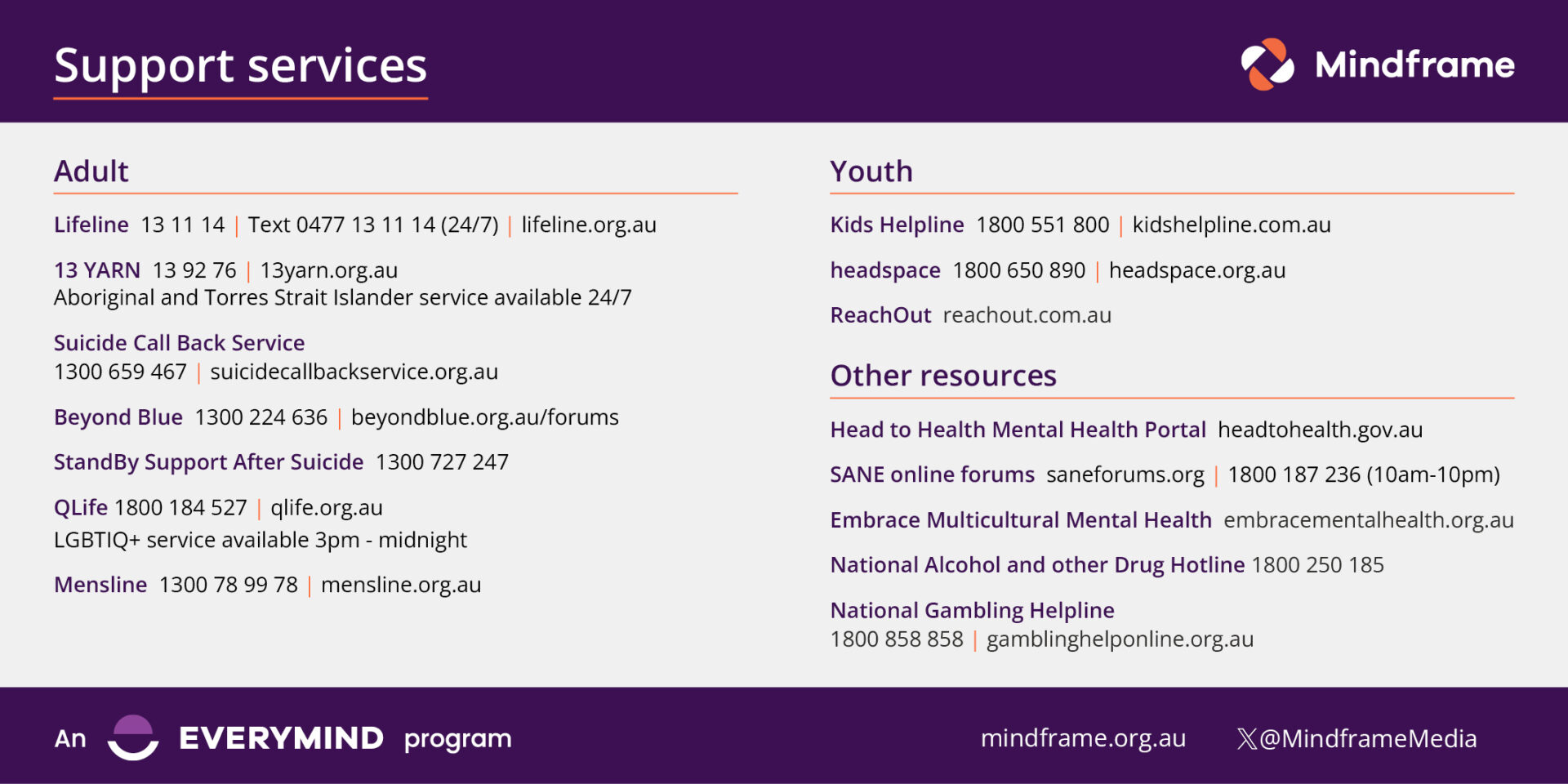
If you, or someone you know is in immediate danger, please call 000, visit your nearest hospital emergency or contact any of the crisis support services.
Data and statistics can help to provide context and understanding of the prevalence and impacts of suicide, mental health concerns and alcohol and other drug concerns in Australia. To support reporting, a high-level overview of key suicide statistics and patterns across the population is provided below, as well as links to authoritative data sources for more information.
Care should be taken to present data accurately and in context. Avoid selectively using statistics that highlight dramatic or isolated findings, as this can mislead audiences and contribute to sensationalism.
When using suicide data in reporting, refer to the Mindframe: Quick reference guide for communicating safely about suicide and self-harm data.
You can also contact Everymind (mindframe@health.nsw.gov.au) if you would like support on using or reporting on data and statistics.
Suicide
Australian Bureau of Statistics – Causes of Death, Australia
The Australian Bureau of Statistics (ABS) provides in-depth data and statistical information around suicide-related deaths across Australia through their annual Causes of Death release. The Mindframe program supports this release each year by holding a media and stakeholder briefing . A summary of the latest release is below.
ABS Causes of Death data 2024
Released by the ABS on Thursday, 14 November 2025
- In 2024 there were 3,307 deaths by suicide with an age-standardised rate of 11.8 per 100,000.
- The crude suicide rate was 12.2 per 100,000.
- Men had a higher age-standardised suicide rate (18.3 per 100,000) than women (5.5 per 100,000).
- More than three-quarters (76.5%) of people who died by suicide were male.
Snapshot: ABS Causes of Death data release 2024
Australian Institute of Health and Welfare (AIHW) – National Suicide and Self-harm Monitoring System
The National Suicide and Self-harm Monitoring System collates and analyses national data on suicide and self-harm from a number of sources. Data are available on suicide deaths for different age and population groups, as well as geographic areas such as state and some regional data. Other indicators such as self-harm hospitalisations, ambulance attendances and particular risk factors are also available.
Life in Mind
Life in Mind is a knowledge exchange portal providing translated evidence, policy, data and resources in suicide prevention, and host of the National communications charter.
The portal provides easy-to-read summaries of important suicide data releases and other helpful information .
Mental health concerns
Key data sources regarding mental health concerns among the Australian population include:
Australian Bureau of Statistics – National Study of Mental Health and Wellbeing
The National Study of Mental Health and Wellbeing 2020-22 provided information about the prevalence of mental disorders, use of services for mental health and lived experience of suicide and self-harm. An analysis of the data for LGBTQ+ Australians was also released.
Australian Institute of Health and Welfare – Mental health
This section of the AIHW website brings together data from a number of sources on the prevalence and impact of mental illness, access to services and government spending related to mental health.
Alcohol and other drugs
Data on alcohol and other drug use and its impacts are collected in a number of ways in Australia. Key data are available through:
Australian Institute of Health and Welfare – Alcohol, tobacco and other drugs in Australia
This regularly updated web report from AIHW consolidates recent information from several datasets to provide a comprehensive overview of the availability and consumption of alcohol, tobacco and other drugs in Australia, as well as related impacts, harms and treatment. Key surveys and datasets include:
- National Drug Strategy Household Survey (NDSHS) – The primary national survey on alcohol, tobacco and illicit drug use, conducted every 2-3 years, and providing data on prevalence, frequency of use and attitudes in the general population aged 14 and over.
- National Wastewater Drug Monitoring Program (NWDMP) – Collected by the Australian Criminal Intelligence Commission, drug consumption is measured by analysing wastewater, providing near real‑time insights into population-level drug use.
- Alcohol and other drug treatment services – AIHW collects information on publicly funded treatment services and client characteristics
24/7 support is available